Advanced Logistics Platform Synergies with Italian 3PL/4PL Providers

[7' VIDEO OVERVIEW in English is available for this complex Content at this LINK ]
[16' AUDIO DEBATE in English is available for this complex Content at this LINK ]
Introduction
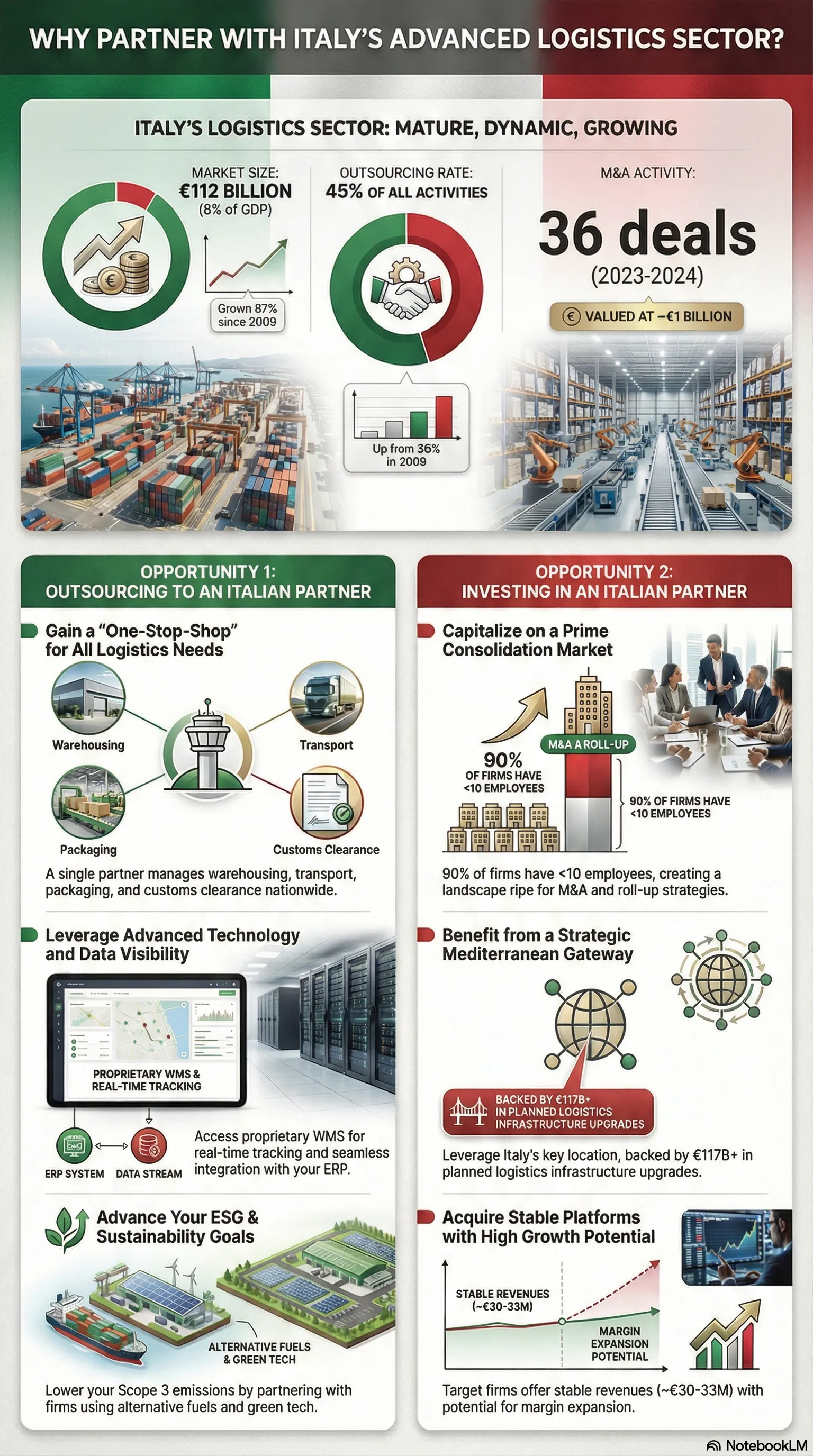
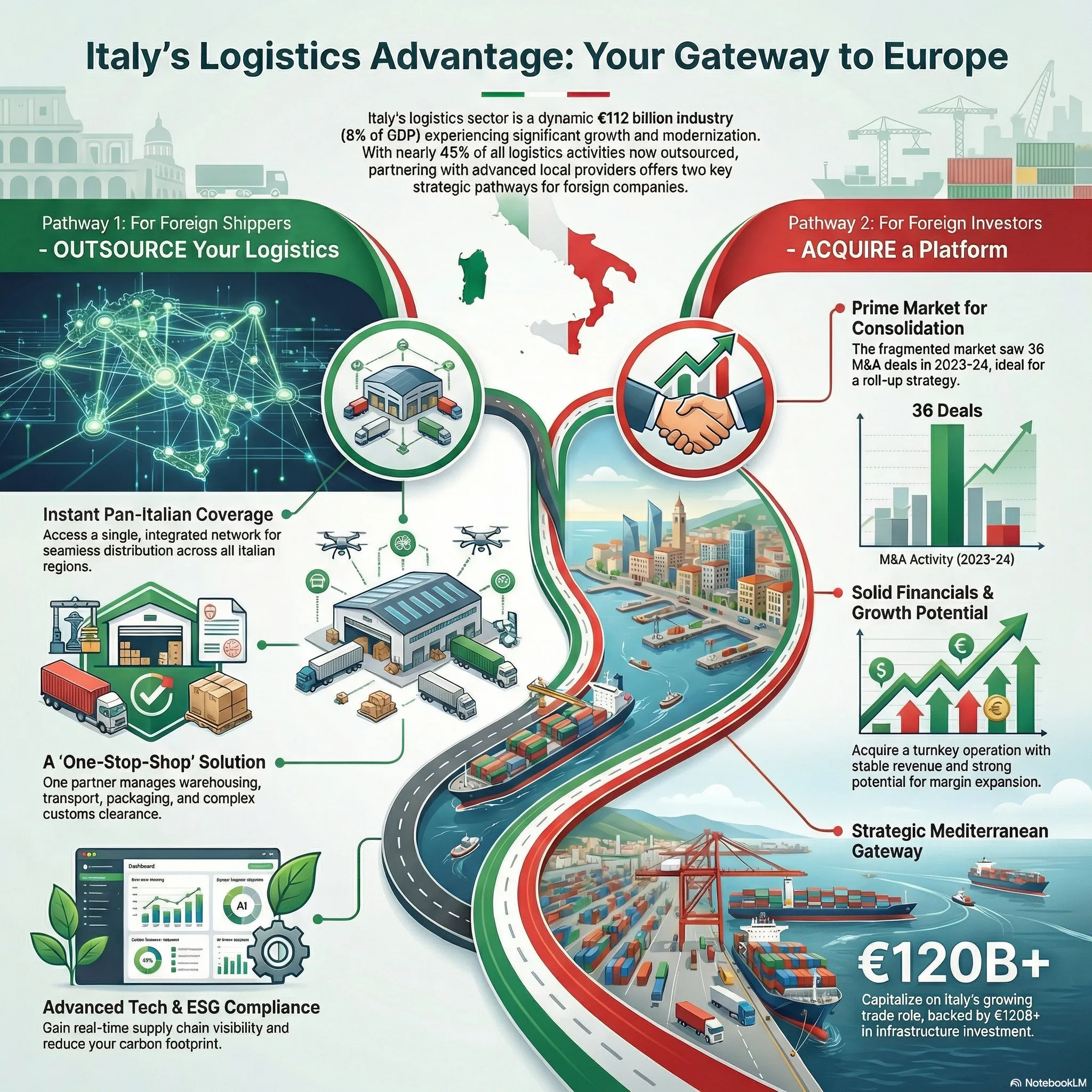
Foreign companies can gain significant operational and strategic advantages by partnering with advanced Logistic Platforms managed by Italian third-party/fourth-party logistics (3PL/4PL) providers. Italy’s logistics sector is mature yet dynamic – it was a €112 billion industry in 2023 (8% of GDP), having grown 57% since 2009. Outsourcing logistics is now common practice in Italy, with nearly 45% of all logistics activities entrusted to external providers (up from 36% in 2009). The example of a representative mid-sized Italian logistics company (with nationwide coverage, proprietary IT systems, and multi-sector services) illustrates the benefits available. This example provider operates a comprehensive network (roughly 12 distribution hubs and 50+ sites across Italy, with 500+ employees from 20+ nationalities), serving industries from automotive and industrial manufacturing to food and retail. Its company culture emphasizes innovation – “company culture, new technologies, and big data: our leading pillars!” – reflecting a strong commitment to digitalization and continuous improvement. Below, we analyze two perspectives: (1) foreign firms outsourcing their Italian logistics to such a provider, and (2) foreign logistics operators or investors forming partnerships or acquisitions. Key operational and financial performance indicators of the example company are also provided as benchmarks.
Benefits of Outsourcing Logistics to an Italian 3PL/4PL Provider
For a foreign manufacturer or retailer looking to outsource logistics in Italy, partnering with a capable local 3PL/4PL offers numerous operational benefits and strategic conveniences:
Nationwide Integrated Network and Local Expertise
An advanced Italian logistics provider delivers true pan-Italian coverage. The example company’s infrastructure spans the entire country, enabling it to support customer operations “wherever” they are located. A nationwide integrated platform means foreign companies can rely on a single logistics partner for all Italian regions, rather than juggling multiple local carriers or warehouses. The local expertise embedded in such a network ensures familiarity with regional regulations, infrastructure, and market nuances. Deliveries are optimized for speed and reliability, leveraging the provider’s dense distribution hubs and last-mile reach. In short, a foreign shipper gains an immediate “in-country” logistics arm with on-the-ground knowledge, ready to distribute products anywhere in Italy on short notice.
One-Stop-Shop: End-to-End Logistics Services
By outsourcing to a full-service Italian 3PL/4PL, foreign companies enjoy the strategic advantage of a single point of contact for all logistics needs – warehousing, transportation, packaging, even customs support. The representative provider, for example, offers an integrated suite of services under one roof. Its capabilities include: modern warehouse management (storage of raw materials and finished goods, including operation of bonded customs warehouses for deferred duties), industrial packaging (e.g. spare parts packaging and kitting), and nationwide transport management (domestic trucking and international freight). In practice, this means a foreign firm can entrust the Italian partner to receive inbound goods at port, store them, pick & pack orders, handle customs clearance, and deliver to end customers – all coordinated by one provider. Such end-to-end handling simplifies communications and reduces hand-offs (and errors) between multiple vendors. It also enables better synchronization of the supply chain. For instance, inventory can be dynamically reallocated between warehouses and transport routes optimized in real-time by the single 3PL orchestrator. Overall, the foreign company gains supply chain agility and simplicity – instead of managing separate warehouse operators, trucking companies, and customs brokers, the 3PL serves as a one-stop solution accountable for the entire logistics process.
Advanced Technology and Supply Chain Engineering
Italian 3PL/4PL leaders distinguish themselves through technology and engineering capabilities that drive efficiency for their clients. A key benefit to foreign shippers is access to the provider’s proprietary IT platforms, such as Warehouse Management Systems (WMS). With this system, real-time track-and-trace capability gives foreign clients end-to-end visibility into their products – they can monitor stock levels, shipment statuses, and delivery times through dashboards or data feeds. Moreover, the provider’s systems integration means the WMS can interface with the client’s ERP or supply chain software, ensuring seamless data exchange (orders, inventory updates, shipping alerts, etc.).
In addition to IT, top Italian 3PLs offer supply chain engineering expertise. The example firm’s approach to outsourcing is built on engineering complex logistics flows and continuous optimization. Concretely, the 3PL can design warehouse layouts and distribution models tailored to the client’s needs – for instance, setting up just-in-time (JIT) delivery sequences for automotive assembly lines, or implementing kanban systems and kitting operations to streamline manufacturing supply. This engineering know-how allows foreign companies to improve their Italian supply chain performance beyond basic freight movement. The 3PL can re-engineer processes to reduce lead times, right-size inventory, and minimize costs. In essence, the client gains a local “supply chain engineering department” through the partnership, leveraging the provider’s experience in optimizing logistics for the Italian market.
Quality, Certifications and Value-Added Services
Partnering with an advanced Italian logistics operator also assures high standards of service quality and compliance. The example company holds multiple internationally recognized certifications – ISO 9001 (quality management), ISO 14001 (environmental management), and ISO 45001 (occupational health & safety) – reflecting its adherence to rigorous process and continuous improvement. For a foreign client, these certifications provide confidence that the 3PL’s operations (warehouses, handling, etc.) meet global best practices and regulatory requirements. In practical terms, the provider has documented procedures for inventory accuracy, traceability, cleanliness, and risk management, reducing the likelihood of supply chain disruptions or quality issues. Many Italian 3PLs also comply with industry-specific standards (such as GDP for pharmaceuticals or IFS for food logistics) to serve specialized sectors.
Another value-added capability is the management of customs and regulatory logistics. Italy, as an EU gateway and major import/export hub, has complex customs procedures – but a local 4PL can simplify this for foreign firms. The example provider, for instance, operates customs-bonded warehouses and manages inter-operational customs processes. This enables foreign importers to store goods in Italy under bond (deferring duties/VAT until sale) and to handle re-export or intra-EU distribution with minimal friction. The 3PL’s in-house customs expertise and status (e.g. AEO certification) means faster clearance and compliance with Italian/EU trade laws on the client’s behalf.
Finally, foreign companies benefit from various ancillary services the Italian 3PL can provide around the core logistics. These may include packaging and repacking services, labeling, product inspections, reverse logistics (managing returns), and even light manufacturing or assembly postponement. For example, the partner could perform final packaging or customization of products in its Italian warehouses to meet local market requirements. By consolidating these services with the logistics provider, a foreign firm can reduce the need to perform or outsource them elsewhere, thus lowering overall costs and shortening the supply chain.
ESG and Sustainability Advantages
A modern Italian logistics partner can also advance a foreign company’s sustainability and ESG goals. Sustainability has become a priority in Italy’s logistics sector, with providers investing in greener operations and certifications.
One major advantage is reduced carbon emissions in the logistics chain. Italian 3PLs are increasingly adopting low-emission technologies: using alternative fuels (biofuels like HVO or Bio-LNG) in trucks, optimizing route planning to cut mileage, and shifting freight to intermodal rail where possible. In 2024, leading Italian operators achieved significant emissions cuts – for instance, the CO₂ intensity of one fleet dropped from 0.840 to 0.722 kg CO₂ per km (≈14% reduction) thanks to alternative fuels. Many providers are procuring electric or Euro 6 vehicles and installing solar panels on warehouses to reduce their carbon footprint. By outsourcing to such a 3PL, a foreign company effectively outsources part of its sustainability effort as well – the provider’s greener practices will directly lower the Scope 3 (logistics-related) emissions of the client’s supply chain. In addition, Italian logistics firms often pursue green certifications (e.g. ISO 14064 for greenhouse gas measurement or LEED for warehouse facilities).
Waste reduction and efficiency are another sustainability benefit. The 3PL’s advanced WMS and process controls help minimize waste (e.g. optimizing packaging to reduce material use, using reusable containers, etc.) and prevent product losses or damage. And because the provider consolidates loads and improves truck fill rates across clients, it can eliminate needless trips – meaning fewer trucks on the road per unit of goods delivered. Furthermore, the example company’s commitment to worker safety (ISO 45001) and ethics implies an ESG advantage: foreign firms can be assured that labor conditions in their Italian logistics operations meet high standards, aligning with their corporate social responsibility goals. In summary, partnering with a sustainability-minded Italian 3PL can help foreign companies achieve lower emissions, improved energy efficiency, and compliance with ESG criteria in their supply chain, all while benefiting from Italy’s broader push toward greener logistics.
Foreign firms that outsource to an Italian 3PL with the above profile can expect: a seamless entry into the Italian market’s logistics infrastructure, consistent service quality backed by certifications, advanced technology integration, and improved sustainability of their operations – all delivered through one reliable partnership.
The next section examines what opportunities exist for foreign logistics companies or investors when they consider deeper partnerships or investments in such Italian providers.
Opportunities for Foreign Logistics Operators and Investors in Italy
For international logistics companies or financial investors (e.g. logistics groups, private equity) looking at Italy, partnering with or acquiring a mid-sized Italian 3PL/4PL can be a highly strategic move. The Italian market’s characteristics – fragmentation, ongoing consolidation, and specialized know-how – present opportunities to both unlock financial value and expand service capabilities. Using our representative company as a benchmark, we explore key considerations:
Financials Resilience and Growth Potential
Mid-sized Italian logistics providers typically demonstrate steady operations with potential for margin expansion. The example company, for instance, generates annual revenues around €30–33 million and maintains positive (if slim) profitability.
Despite operating in a challenging low-margin environment, the target provider must demonstrae a financial resilience.
A well-run mid-sized Italian 3PL can sustain itself through industry cycles and has upside for profitability improvements. An injection of capital or integration into a larger network could likely boost margins (through economies of scale and technology upgrades). From an investor perspective, a very likely potential value uplift stems from streamlining operations, automating warehouses, or sharing volumes with an acquirer’s existing network. Additionally, a stable revenue base (~€30M/year across diversified clients/sectors) provides a solid platform for growth. The presence of established assets (fleet, warehouses) and skilled workforce means an investor is acquiring a turn-key operation that can be scaled further with additional business.
Market Consolidation and Expansion Trends
The Italian logistics sector’s structure presents a clear opportunity for consolidation. It remains highly fragmented – an estimated 90% of Italian logistics firms have fewer than 10 employees, often family-run trucking or warehousing outfits. However, the industry is actively consolidating as stronger players absorb smaller ones. In 2023–2024, roughly 36 M&A deals took place in the Italian logistics market (worth about €1 billion), continuing a trend of roll-ups. This consolidation momentum is a chance for foreign logistics groups or investors to enter and expand quickly. By acquiring a capable mid-sized 3PL (like our example firm, with 100s of staff and nationwide reach), a foreign player secures a strong platform in Italy and can then consolidate smaller regional operators into it. Such a roll-up strategy achieves instant scale, turning a medium provider into one of the top national logistics companies. The benefits include combined warehousing capacity, integrated transport fleets, and a broader customer base – which drive higher asset utilization and efficiency.
Furthermore, many mid-sized Italian logistics companies are at a generational crossroads. They are often family-owned (first or second generation) with owners considering retirement or lacking succession. This makes them receptive to partnership or acquisition offers. Indeed, the market has a “pipeline of medium firms open to foreign capital” due to these succession dynamics. A foreign investor can present an attractive exit or growth plan to the owners: by selling or partnering, the family company can secure its legacy and offer new career paths for its staff, while the investor gains a well-run business with an entrenched market presence and loyal clientele. It’s a win-win that smooths the M&A process.
Italy’s strategic location and improving infrastructure also underpin expansion opportunities. The government and EU have committed massive investments to logistics infrastructure – approximately €117 billion for rail freight connectivity and €5.8 billion for port upgrades by 2026. These projects (expanding rail corridors, modernizing ports like Genoa and Trieste) will increase freight capacity and efficiency. An investor aligning with an Italian 3PL can capitalize on this by expanding intermodal services. For example, an acquired provider with operations at a key port or intermodal terminal can scale up to handle greater volumes as new rail lines and terminals come online. In addition, Italy’s role as a Mediterranean gateway is growing in importance – as global supply chains reconfigure (e.g. nearshoring trends and diversification away from single sources), Italy is poised to receive more Asia–Europe and intra-Med trade. A foreign logistics group could leverage an Italian subsidiary to serve as its Southern European hub, capturing flows that go through Italian ports and distributing onward to EU markets. In short, the combination of fragmentation (many targets available), consolidation trend (active M&A environment), and infrastructure expansion makes now an opportune time for foreign investors to establish or enlarge a foothold in Italy’s logistics sector.
Platform Synergies and Technology Collaboration
Beyond financial metrics, a partnership or acquisition can unlock significant operational synergies and service enhancements. Foreign logistics operators can co-develop logistics platforms with the Italian provider, integrating systems and networks to create a stronger combined offering. For instance, an international 3PL that acquires an Italian firm gains that firm’s proprietary tools, such as its WMS and customer-facing portals. The example company’s advanced WMS (with AI and real-time data capabilities) could be leveraged across the investor’s broader platform. Investors explicitly seek targets with “technologically advanced operations (modern WMS, track-and-trace systems) that can be leveraged across their platform”. By rolling out the Italian provider’s tech solutions to other regions – or conversely, by upgrading the Italian operations with the investor’s own advanced systems – the unified company can improve efficiency and transparency for all clients. Joint development of IT (for example, a unified tracking system covering end-to-end shipments across countries) can be a competitive differentiator.
There are also opportunities to expand cross-border services in collaboration with an Italian 3PL. A foreign logistics group can plug the Italian partner into its global network, enabling, for example, direct China/US–Italy inbound logistics solutions, which can then feed into the partner’s domestic distribution system. The Italian provider becomes the group’s specialty arm for that geography, handling local warehousing and last-mile. Conversely, the Italian firm can help the foreign operator offer new services to Italian exporters – e.g. managing export logistics from Italian factories to European distribution centers, leveraging the foreign operator’s cross-border transport assets. By co-developing these services, both parties can capture more of the supply chain value.
Additionally, 4PL (lead logistics) capabilities can be enhanced through partnership. Italian providers are evolving into 4PL roles, offering control-tower management of complex supply chains. With outsourcing on the rise (95% of large Italian firms outsourced export logistics in 2023), the demand for such integrative services is high. An investor can cultivate the Italian partner as a center of excellence for 4PL solutions, using its expertise to orchestrate logistics for clients not just in Italy but across Southern Europe. For example, the Italian team’s success with an AI-driven control system could be replicated in other countries the investor operates in, giving the entire group a cutting-edge, tech-enabled service offering. Overall, the partnership creates a two-way street of innovation: the foreign company brings capital and perhaps global best practices, while the Italian company brings local knowledge, proprietary tech, and a flexible entrepreneurial mindset, together developing superior logistics platforms.
Cultural and Managerial Strengths
Foreign investors will also find cultural and human capital strengths in Italy’s advanced 3PLs that can be harnessed for long-term success with a management team which is “strongly oriented to both technological and human resources growth, with client-satisfaction as a mission, focusing business vision towards solid partnership”. This ethos indicates a collaborative approach – the team values innovation and skills development, and seeks win-win partnerships (with clients and presumably with investors). For a foreign acquirer, working with an existing management that already embraces continuous improvement and has alignment on goals makes post-merger integration much smoother. It reduces the risk of culture clash and ensures the local team will proactively drive the business forward under new ownership.
The workforce of Italian 3PLs is another asset. Our example provider employs over 500 staff from 20+ nationalities, reflecting a diverse and multicultural talent pool. Such diversity can be a strength in serving international clients – employees bring multilingual abilities and cross-cultural understanding, which is beneficial when coordinating with global customer teams. Moreover, Italy’s logistics workforce is experienced in dealing with the country’s regulatory and infrastructure context, which might be complex for outsiders. Bringing these skilled people into a foreign operator’s organization infuses valuable local expertise. Investors should note that while the sector faces labor shortages in areas like truck drivers, companies that have a track record of investing in their people (training, safety, good working conditions) will retain talent better. The example company’s reduction in staff turnover and strong safety performance (as implied by ISO 45001 certification) likely means a stable workforce ready to grow under a new partnership.
Another strength is the innovative mindset many other mid-tier Italian logistics firms have not adopted yet to compete with global giants. Only half of Italian logistics operators derive >10% of revenue from advanced services like kitting, assembly, reverse logistics, and supply chain consulting – indicating a willingness to go beyond basic transport/warehousing. This innovative service portfolio adopted by the example provider can be leveraged by a foreign partner to enhance its own offerings. For example, an investor could take an Italian firm’s expertise in fashion or luxury goods logistics (areas where Italian 3PLs are skilled) and extend those niche services to other markets. Culturally, Italian firms also excel in customer service and flexibility – they are used to tailoring solutions for demanding clients (e.g. high-end automotive or fashion brands) and reacting quickly to changes. This agility and customer-centric approach can benefit a larger organization if spread through training and best practice sharing.
Finally, Italian companies tend to have strong compliance and governance frameworks when they reach a certain size, due to EU regulations and client requirements. The example 3PL’s adherence to safety, environmental, and ethical standards means it has a culture of compliance aligning with international standards. A foreign investor can take comfort that issues like labor compliance, health & safety, and environmental impact are well-managed locally, reducing reputational risk. It also means the Italian unit can be a leader in ESG initiatives within the broader group.
Conclusion
In summary, partnering with or investing in a capable Italian 3PL/4PL Logistic Platform offers foreign companies a combination of financial upside, strategic market entry, and operational synergies. The investor gains a ready-made platform in a major European market – with robust infrastructure and customer base – and the chance to scale it rapidly via consolidation. At the same time, they inherit several assets: cutting-edge IT systems, innovative services, a dedicated management and workforce, and a commitment to quality and sustainability. With careful integration and mutual exchange of expertise, a mid-sized Italian logistics provider can become a cornerstone of a multinational logistics network, driving growth and competitive advantage for the foreign partner. As one industry analysis concluded, “the Italian integrated logistics sector offers a compelling mix of scale, growth, and strategic value for international acquirers. The right acquisition, backed by careful integration and investment, can transform an Italian medium logistics provider into a cornerstone of a pan-European logistics platform.”
By leveraging these benefits – whether as a client outsourcing logistics or as an investor building a larger logistics platform – foreign companies can turn Italy’s advanced 3PL/4PL capabilities into a strategic advantage in their own supply chains and business growth plans.
Why it matters?
Post-pandemic logistics requirements and recent geo-political crises require very innovative and structured consolidated global strategies. Italy is an excellent variable to be factored into winning "Logistics Equations".
If you wish to know more about WHAT / HOW WE DO in P&P:
- •[email protected]
- •visit P&P Knowledge Forum at "Cosa Facciamo" page
Source
P&P's Alternative Intelligence TEAM:
ChatGPT-5.2 Pro's Analysis,
NotebookLM Pro's Audio / Video Overviews and Infographics,
Nicola Antonucci 's Strategic Advisor Know-How